A Practical Guide to Working with TeenagersWhat local government, companies and the press decide first
5 min read
TEIGEN JP is a student-led organization founded in June 2023 in Adachi City, Tokyo. Thirty-eight high school and university students (as of June 2026) work across two pillars: civic education and youth participation, and cleanup education and public-mindedness.
There is one thing we can say from having worked with local government, assemblies, schools, companies and the press.
This page lists what to settle first, position by position, and points to the practical articles.
For local governments, councils and election administration commissions
Raising turnout among young people is known to respond poorly to the sheer volume of awareness material. Turnout among 18 and 19 year-olds in the 2022 House of Councillors election was 34.49% (Ministry of Internal Affairs and Communications). Read as proof of low interest, that figure pushes responses towards publicity.
What you settle first is the target group, the timing, the outcome and the arrangement — four things.
- Aim earlier than the eve of turning 18
- Time it to the school's annual plan and approach them by the autumn of the previous year
- Write the outcome not as turnout alone but as "how many people had the experience of deciding what"
- Do not co-host in the first year; begin with advice and an endorsement
The articles are here.
- Planning civic education and voter awareness at a local authority | Setting the target group, the timing and the outcome — the four decisions, set out in tables
- How to hold a mock election in your own town: approaching the local authority and the election commission — the difference between co-hosting, endorsement and cooperation, and what to ask at the first meeting
- Political neutrality in schools: what a class can do and what it should avoid — the point that always comes up when a public body is involved
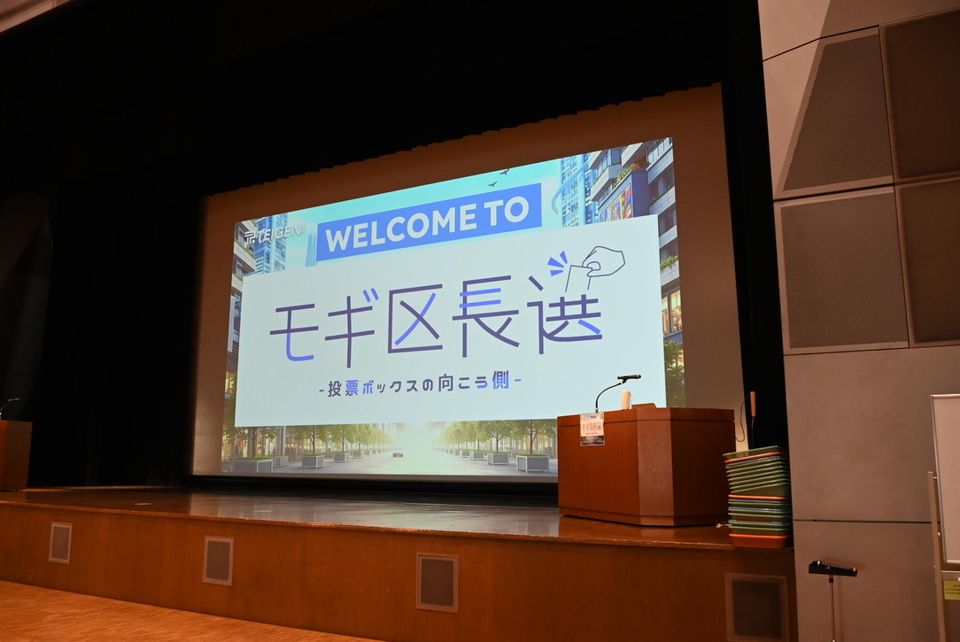
TEIGEN JP runs the "Mock Ward Mayoral Election" together with Adachi City Hall, the city assembly, the board of education and the election administration commission. At the 2025 edition, 30 junior and senior high school students took part and 11 city assembly members helped. As institutional design research, we publish the Adachi City Youth Council Proposal, a five-stage design for connecting the voices of 13 to 24 year-olds to policy-making.
Enquiries are handled through Contact Us.
For companies and foundations
Working with a teenage organization comes in sponsorship and donation / co-creation (programme development) / speaking and training — three forms. Mix them and none of them works.
Many efforts take the shape of sponsorship while intending co-creation, and all that is left is a report. A relationship that only supplies money does not change in quality as the amount rises. By contrast, a relationship that turns your own expertise into teaching material leaves assets on both sides.
- When a company works with teenagers | Designing co-creation that does not end at sponsorship — using the three forms distinctly, and four things to record for internal reporting
- Booking a teenage speaker: designing the session so it is not just "the voice of youth" — when you are asking for a session at a staff event or training day
TEIGEN JP developed the curriculum for "Protect Our Town! Osouji-tai", an outreach class in cleanup education for elementary schools, with the cooperation of Duskin Co., Ltd. We publish how support is spent in five categories; in our 2026 crowdfunding, 26 people gave a total of 279,000 yen, 139% of the goal.
The partnership options are set out on Partnerships with schools and municipalities, and enquiries are handled through Contact Us.
For press and media
Whether we can answer quickly about an interview depends on whether your message states the outlet, the theme, the range of what you want to ask, the format, preferred dates and when it will run.
Care owed to minors should be checked as three separate things: how far the name is made public, how the face appears, and secondary use. Consent takes days to obtain, so telling us the publication date first lets us select people who can make it.
- Interviewing a teenage organization | How to write the request, and the care owed to minors — the six items a request needs, how to build questions, and how to run fact-checking
Our fact sheet and founder profile are published in the Newsroom. For fact-checking and interview requests, please write to contact@teigenjp.org with 【取材】 (interview) in the subject line.
For schools and boards of education
What you settle when it runs as a class is how many periods, when, and for which grade. Guidance for schools is gathered on a separate page.
- Enquiry Guide to Civic and Cleanup Education — an index by position
- What civic education is | Five points to settle before teaching it — how to design the class
Things checked whatever your position
Neutrality
TEIGEN JP, as an organization, neither supports nor opposes any particular party or candidate, and does not steer anyone's vote. That policy was agreed by our board and is published. Our classes do not treat real parties, candidates or the pros and cons of live issues; participants compare policies they have drafted themselves.
Information about members who are minors
is published only within the range the member has consented to, and in places is anonymised to school year and area alone. Please let us keep to the same range for interviews and publicity material.
Definitions of figures
Every figure we publish carries the date it refers to. Definitions and sources are given in Results and Recognition. When quoting, it helps if you keep the date — for example "38 members (as of June 2026)".