What is civic education?A primer for schools, and five common pitfalls
6 min read
Since the voting age was lowered to 18, civic education has been taken up by many schools.
What that means in practice, however, differs greatly from school to school. Some lessons explain how elections work, some let students experience mock voting, and some go all the way to drafting policy.
What people hesitate over at the start is how far it is acceptable to go. Go too far and neutrality becomes a worry; hold back too much and it ends as a check of factual knowledge.
This article sets out five issues that most often trip schools up when they begin.
Who this is for
- Teachers taking on civic education for the first time
- Those who tried mock voting and felt it did not land
- Administrators unsure where to draw the line on political neutrality
- Those who want to connect it to inquiry time or student council activities
- Local government and board of education staff designing programs
Issue 1 | Do not stop at practising how to vote
Mock voting is easy to introduce and students respond well to it.
But if you isolate the vote itself, what students experience is only choosing from options already prepared for them.
What is hard in real politics is not choosing but creating the options, allocating limited resources, and explaining yourself to those who disagree.
| Design | What students experience | What stays with them |
|---|---|---|
| Explanatory | Knowledge of the system | Understanding of terms |
| Mock voting | The procedure of choosing | The feel of a polling place |
| Policy drafting and candidacy | Creating, allocating, explaining | A feel for decision-making |
| Connected to the real system | Reaching actual policy-making | The experience of having changed something |
Article 137-2 of the Public Offices Election Act prohibits election campaigning by those under 18. Even resharing a candidate's post can fall within the restriction. Teenagers therefore reach the day they gain the vote having had almost no chance to practise taking part in politics, and become citizens with a ballot overnight.
That is precisely why preparing the experience of standing on the side that creates inside school matters.
Issue 2 | Secure neutrality through what you take up
Anxiety about handling politics is usually anxiety about bringing real political conflict into the classroom.
That can be resolved by separating what you take up.
- Do not take positions on real parties, candidates or contested issues
- Have students compare the policies they themselves drafted
- The teacher holds no conclusion and asks only whether the reasoning holds
You can reproduce the structure of decision-making without importing real conflict.
TEIGEN JP itself neither supports nor opposes any particular party or candidate and does not steer anyone's vote. Our board agreed on this policy and we have Published it.
The detailed boundaries are set out in Political neutrality in schools: what a class can do and what it should avoid.
Issue 3 | With limited periods, decide first what to give up
Almost no school can secure enough class periods for civic education.
To make it work within the time you have, decide first what to give up rather than what to add.
| Periods | What to keep | What to give up |
|---|---|---|
| 1 | The moment of decision (comparison and vote) | Drafting, speeches |
| Two periods | Drafting, and answering questions | Election bulletins, deliberation |
| Four periods | The whole arc, from analysis to vote | Revising policy afterwards |
TEIGEN JP's outreach program for junior high and high schools runs 2 to 4 periods, 30,000–50,000 yen per session (plus travel and venue costs at actual expense). If only one period is available, we take it on as a talk rather than a lesson.
Designs for each amount of class time are covered in detail in Designing a mock election class: what to keep and what to go deeper on, in two periods versus four.
Issue 4 | Connect to time you already have
Without creating a new unit, schools already hold time that connects to civic education.
- Period for Inquiry-Based Cross-Disciplinary Study — if you take up local issues, you can insert the moment of decision → Taking up local issues in inquiry-based study
- Student council elections — can become preparatory study in comparing pledges → Preparing for a student council election
- Special activities and moral education — contain moments that address how one engages with the public
- Cleaning activities — the nearest public space of all → Turning school cleaning time into learning
Restating the purpose of time you already have gets you there faster than carving out new time from nothing.
Issue 5 | Assess the process, not the conclusion
Trying to grade proposals on quality pushes assessment towards the subjective.
A decision-based design brings out criteria you can assess in the process itself.
- Whose problem did they define the issue as?
- Under the constraints, what did they give up?
- How did they respond to opposing views?
- Can they explain the proposals they did not choose?
All of these appear in the record along the way, not in the final presentation.
An example in practice
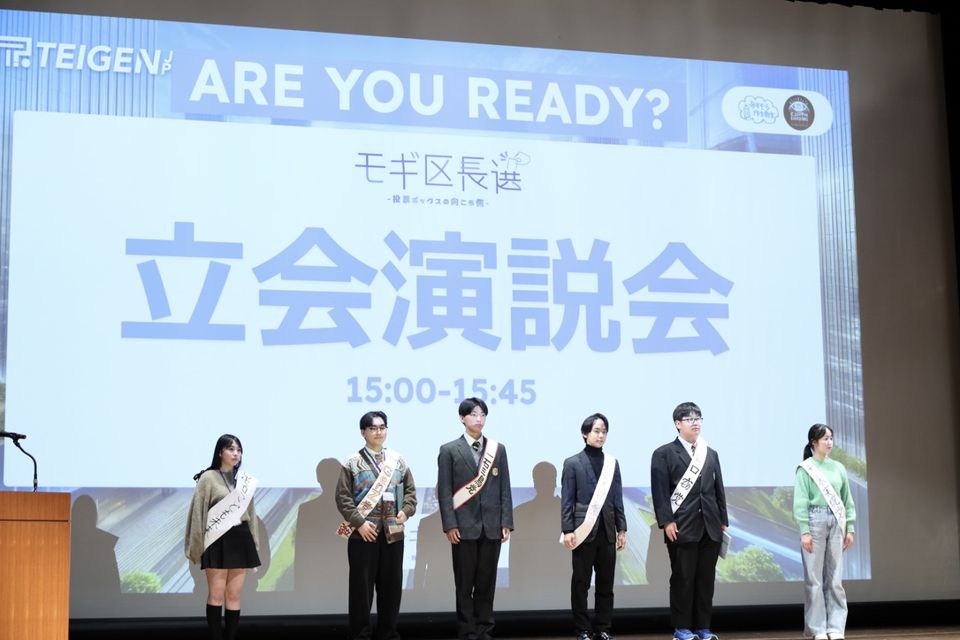
TEIGEN JP runs the Mock Ward Mayoral Election in co-creation with Adachi City Hall, the city council, the board of education and the election administration commission. Participants analyse local issues, draft policy, stand as candidates, produce election bulletins and speeches, deliberate with council members and other participants, then compare policies and vote.
The 2025 edition drew 30 junior high and high school students, with 11 city council members taking part.
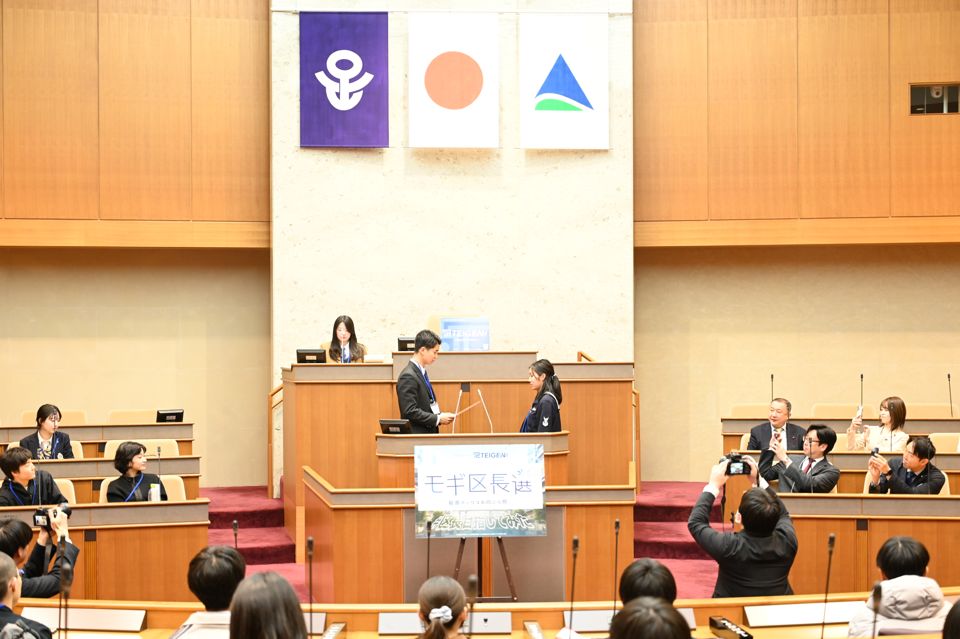
The questions council members ask — where will the funding come from, how will you explain this to residents who object — are not in any reference material. Answering them is what changes a proposal.
As institutional design research, we publish the Adachi City Youth Council Proposal, a five-stage design for connecting the voices of 13 to 24 year-olds to policy-making.
Who
Enquiries from schools and boards of education are handled through Contact Us, and those from local governments and councils through Contact Us. It is fine to get in touch before you have decided whether or when to run it.
Entry points by role are collected in Enquiry Guide to Civic and Cleanup Education.