Turning school cleaning time into learningDesigning cleaning instruction in elementary school
7 min read
Almost every elementary school has cleaning time every day. It is built into the timetable and into classroom management, and it is unlikely ever to disappear.
Even so, lesson plans written for cleaning time are strikingly few compared with those for Japanese or mathematics.
As a result cleaning easily becomes something done because it is scheduled, and instruction drifts towards prompts like do it quietly and get into the corners.
This article looks at the structure that turns cleaning time into a chore, and at how to design it back into learning.
Who this is for
- Homeroom teachers who feel cleaning time has become a rota
- Those troubled by the gap between pupils who work hard and those who do not
- Those who want to explain what cleaning is for in words children understand
- Those who want to link cleaning to classroom management or moral education
- Those who want to connect cleaning to the community and to public space
- Those considering a cleaning lesson led by an outside instructor
Cleaning becomes a chore because its purpose goes unspoken
School cleaning holds at least three different purposes at the same time.
| Aim | What it involves | How easily it is noticed |
|---|---|---|
| Keeping the environment usable | Keeping the classroom in a usable state | High (you can see it) |
| Acquiring skills | Using tools, following procedure, staying safe | Moderate |
| Growing public-mindedness | The disposition to keep your own space in order yourself | Low (hard to see) |
Of these, almost the only one that gets put into words day to day is keeping the environment usable. The floor is dirty, rubbish is left, it did not finish in time — only what is visible becomes the subject.
The third — the one we most want to spend time growing — is the least spoken about. That is where cleaning starts drifting into a chore.
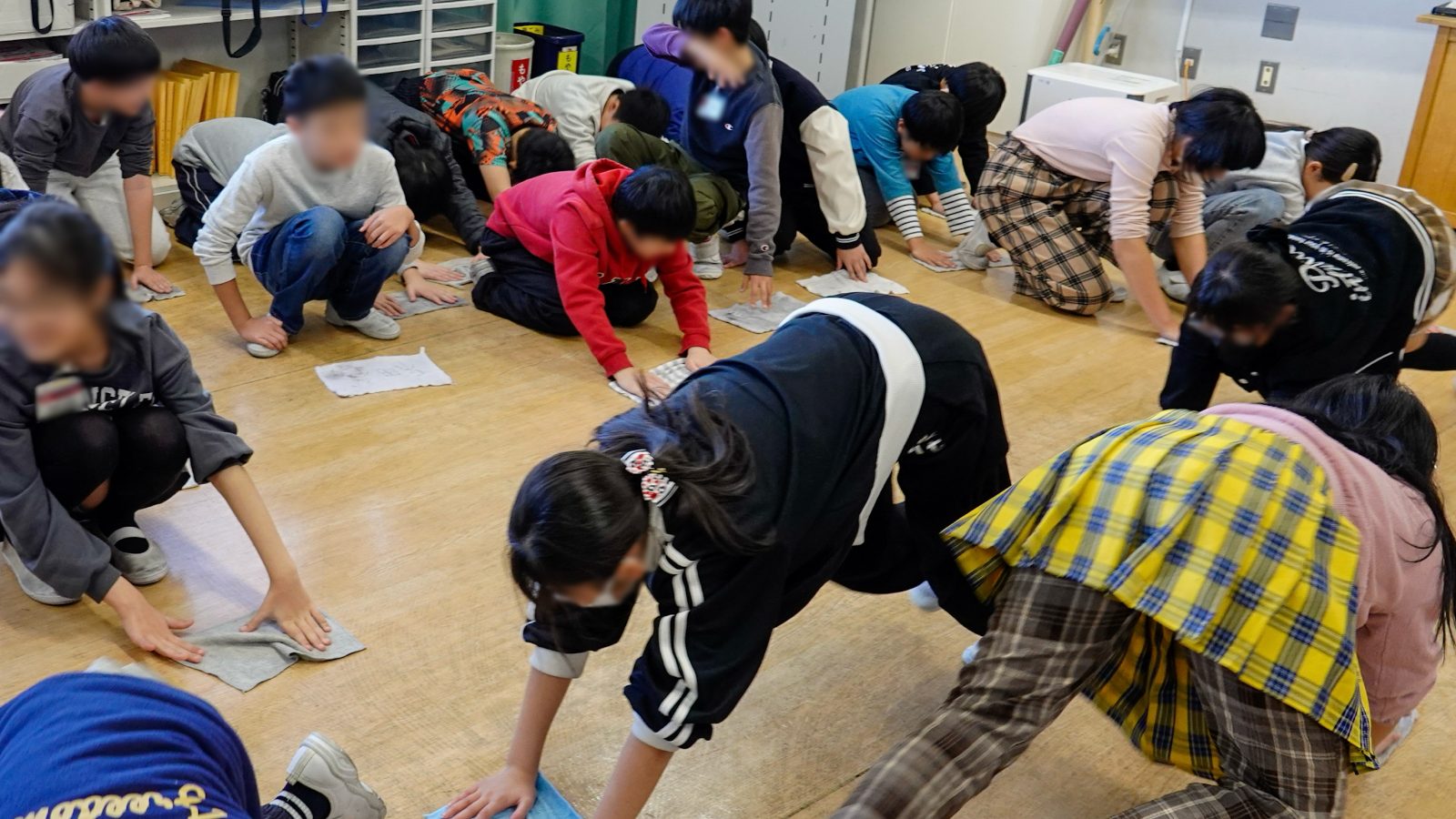
From the pupils' side, cleaning becomes something to finish. Finishing early means more free time, which even creates a structure where the more careful you are, the worse off you are.
Ask first: why do we clean?
Simply changing the order of instruction changes what cleaning time means.
In most classes cleaning starts with how to do it: how to hold the broom, how to wring the cloth, who covers which area. Starting from technique is natural, but on its own the purpose is never spoken about at all.
So put a question first.
The question is there not to deliver an answer but so that children think.
In schools abroad, cleaning is usually done by contractors. Japanese school cleaning, in which pupils put their own space in order themselves, is an unusual educational culture by world standards. TEIGEN JP includes members who have been educated both overseas — in New Zealand and Canada among others — and in Japan.
Learning how other countries do it makes what you do every day stop being obvious. The moment it stops being obvious is the first moment you can think about why.
Place cleaning as the nearest form of social participation
Putting your own classroom in order is the first contribution to the public a child can experience.
The cleanliness and appearance of a town are not maintained by anyone special; they are maintained by what each person does. Cleaning is where that relationship can be experienced at the shortest distance.
So in instruction, treat these three separately.
- Your own space — your desk, your locker, what you used
- Shared space — the classroom, corridors, stairs, toilets
- The town's space — the route to school, parks, community facilities
Your own space feels obvious to take care of. Shared space: if you skip it, you alone are not inconvenienced. The town's space: if you skip it, no one notices at all.
Working through this distinction with children shifts the conversation during cleaning time from whether it is finished to how far they can regard a space as their own.
Small designs you can try in class
Some things can change tomorrow without any elaborate preparation.
1. Put a question, just 30 seconds, before cleaning
Add a single line: where, and for whom, will you put things in order today? It need not be daily; once a week has an effect.
2. Assign the hard-to-see places on purpose
The work of pupils assigned where no one looks produces no visible result. That is exactly why you should put into words the fact that they did not cut corners there.
3. Turn skills into a chance to teach
Have older pupils teach younger ones, or pupils teach each other, how to wring a cloth or use the tools. Once you are the one teaching, you have to explain why the steps are what they are.
4. Have them write reflections as facts, not impressions
Instead of I did my best, have them write where, for how long and by what method they put things in order. Written as fact, what to improve next becomes visible to them.
5. Connect cleaning to the community
Take up a nearby community topic once — littering, graffiti, how the park is used. Some children will notice that cleaning the classroom and the look of the neighbourhood are the same conversation.
The option of bringing in an outside lesson
It is not easy for a homeroom teacher alone to keep giving cleaning its meaning, because daily instruction leaves little room to restate the purpose.
One approach is to bring in an outside lesson once a year and do that work of meaning-making all at once.
TEIGEN JP runs Osouji-tai, an outreach program for elementary schools whose curriculum was developed with the cooperation of Duskin Co., Ltd. The first session was held at Adachi Municipal Adachi Elementary School in December 2025.
It is for elementary schools, any grade, complete in a single period. The lesson is built in four stages.
| Stage | Content |
|---|---|
| Open | Ask why we clean. Learn how schools abroad differ from schools in Japan |
| Try | Learn methods grounded in professional cleaning expertise, hands on |
| Talk | Discuss what it means to look after your own town, using littering and streetscape as the material |
| Commit | Put what they learned into their own words and carry it into action in the classroom and the community |
It is designed not as a lesson that teaches technique alone, but to grow, through cleaning, the sense that I too am one of the people who make this town.
The lesson is led by high school and university students. Hearing it from a generation walking just a little ahead — neither teacher nor parent — makes it easier for children to take it as their own.
So that it does not end with one lesson
An outside lesson is effective for doing the meaning-making all at once, but on its own everything returns to routine.
What matters is leaving something the class can continue afterwards.
- Keep the declarations children wrote in the lesson up in the classroom
- Draw the line you say before cleaning from those declarations
- Once a term, revisit the declarations and add to them
- Link it to community cleanups and school events
Enquiries from schools and boards of education are received through the form on our website. It is fine to get in touch before you have decided whether or when to run it.